Here is a view of the jimh-Revenge-VeeBerth filler panel, showing the general shape; this is the underside view:
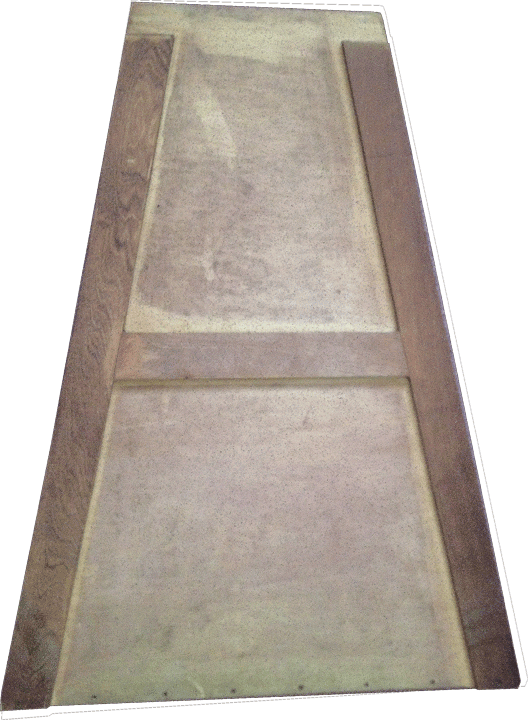
- REVENGE filler panel for vee-berth; underside view. There is some skew in this image that distorts the shape somewhat; the panel is symmetrical about its fore-and-aft centerline.
- fillerPanelUndersideView.png (171.15 KiB) Viewed 4344 times
WIDTH:
--at forward or narrow end = 14-1/2-inches.
--at aft or wide end = 30-5/8-inches
The sides are approximately 40-9/16-inches long.
The main panel is made from Maple plywood with nominal thickness of 7/16-inch ("half-inch"). The plywood thickness is doubled along each side and at a midsection cross brace. These reinforcements are glued in place; no fasteners. The reinforcements were cut from the same plywood, and they are 2-5/8-inches wide. The midsection cross brace is 18-1/2-inch from the narrow end.
The narrow end rests on lip of the cabin footwell where it rises and turns to become the base of the berths. There are 1-3/4-inches of single-thickness plywood that lay over the deck lip.
The wide end rests on the slightly lower part of the cockpit deck. A piece of rubber foam (cut from an old mouse pad whose color is a close match for Pacific Blue) is placed under the panel so it does not abrade the gelcoat. The foam also helps level the panel.
Here is a side view that shows the upper surface and the cross brace at the wide end:
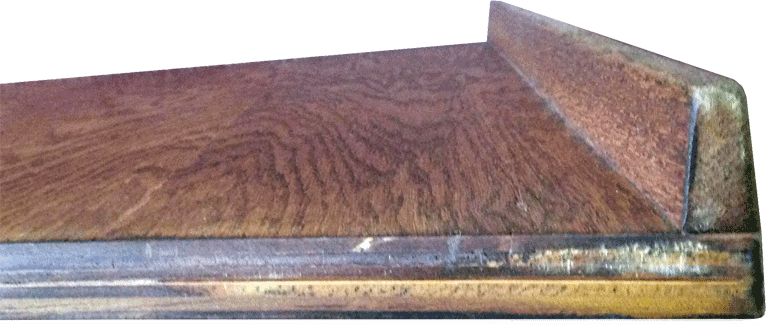
- REVENGE filler panel for vee-berth; side view. At the wide end an Oak beam is fastened to stiffen the panel. It also forms a retainer for the filler cushion that will lay on this panel.
- fillerPanelSideView.png (103.39 KiB) Viewed 4344 times
The beam reinforcement is made from an Oak lumber of 3/4-inch by 1-3/8-inch. To give the beam a more nautical and finished look, the thickness was tapered to 3/8-inch at the top. The beam is fastened to the main plywood sheet with eight wood screws which are countersunk just below the panel surface.
When the panel was darkened with a mahogany wood stain it was discovered that the areas with excess glue did not accept the stain as easily. If you plan to stain the panel underside, carefully mask off the panel when applying the glue for the second layer of plywood so the adhesive does not affect the wood stain. I can't recall the exact adhesive used; it may have been Gorilla Glue. Or it might have been WEST System epoxy resin.
The panel was made in less than one hour. Material selection was based on what was available in the carpenter shop scrap bins. The designed was based on a sketch I made from the boat. The carpentry was done by a friend of mine, a fellow boater, who is skilled at building stage sets, scenery, and displays and had more than 25-years of professional work as a union scenic carpenter in professional theatre.
As best I can recall, I actually made this for my REVENGE 20 W-T. The cabin in the REVENGE 22 W-T is the same, so I just moved it to the larger boat when I bought the 22.
I always intended to sand and even the stain color, then give it a coat of varnish. But my boating ways are not oriented to flashy appearance. In use, 99-percent of the panel is covered by the cushion, and all you can see it that Oak beam or fiddle. It looks quite good enough for me.