For installation of a mounting hinge or other mechanism to support a Bimini Top for a 13-footer, I would not necessarily limit the mounting point location to areas with embedded wood.
I suggest choosing the mounting point so the Bimini Top provides the best shade for the boat occupants
and also folds down nicely either forward or aft into an stowed position that is suitable. If it happens that the mount point coincides with some embedded wood, then all the better. If there is no embedded wood at the most useful mounting point, then I suggest you make your own embedded below-the-laminate layer reinforcement.
When I installed a Bimini Top on my SPORT 15, I experimented with the top frame hinge mount location until I found the best location, again, look for good shade AND a good folded-down location. You may find my comments in an article I wrote about this installation to be useful for your project. See
Adding a Bimini Tophttp://www.continuouswave.com/maintenance-logs/bimini/A method to
create a reinforced mounting point for screw fasteners that is often used is described in another article. I quote my remarks from that article:
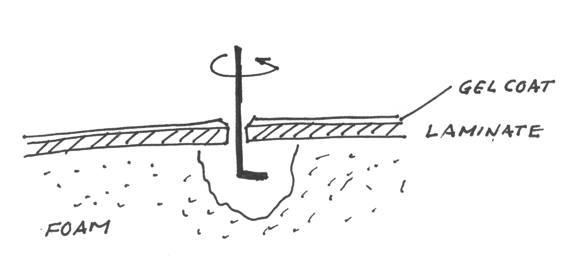
[To make a reinforced attachment point for a threaded fastener]...working with an L-shaped auger through a small diameter hole, dig out the foam behind the laminate surrounding the hole, creating a small pocket or void. Remove the loose foam with a vacuum through the hole. Instill a thickened resin mixture into the hole, filling the void as much as possible--try not to leave any air gaps. You may have to use a syringe to push the resin into the hole and fill the void, then quickly remote the nozzle from the hole; cover the hole with tape to prevent the resin from leaking out as it cures. Do not fill the void with pure resin, as the heat from curing may be excessive and melt more foam. This technique can create a small puck of thickened resin beneath the deck or hull. Drill a new hole into the puck area and install the fastener carefully. If you use epoxy resin you may be able to use a tap to cut threads into it, and then use a machine screw fastener
Note that if the object being fastened to the deck will completely cover the fastener hole, you can made the hole for introducing resin somewhat larger that just the fastener hole. The removed part of the deck will be covered by the component being fastened.
Another method I
described earlier is also reproduced below:
An alternative technique:
--using a cutting tool like a Dremel tool, cut a small portion, say 3-inch by 5-inch, of the deck
--lift out the cut portion of the deck, carefully prying it out of the foam
--carefully carve out an area in the foam in the hull into which you will place reinforcement wood
--undercut the foam under the un-cut deck by at least 0.5-inch
--cut and shape three or four pieces of wood so that they fit into the area created by removing the foam
--using resin and filler as an adhesive, glue the reinforcement wood into the hull interior
--replace the cut out portion of the deck and glue in place with more resin and filler
--fill the cut lines with resin
--top coat the cut lines with gel coat resin to match the original color